First, understand what the Seven Churches are
The Seven Churches of Revelation were early Christian congregations in Ephesus, Smyrna, Pergamon, Thyatira, Sardis, Philadelphia and Laodicea. They were linked by an established route through the Roman province of Asia. They are not seven matching church buildings that survive in the same condition today.
Some places preserve extensive ancient cities; others retain limited remains inside modern towns. This focused journey follows the most practical section between Selçuk and Denizli. For the complete circuit, read our full Seven Churches of Revelation route.
Day 1 · Ephesus, the Church of Mary and St John’s Basilica
Begin at Ephesus, the first congregation addressed in Revelation and one of the most substantial archaeological sites in Türkiye. Its Roman streets, theatre and civic buildings help explain the urban setting in which the early Christian community developed. Inside the site, the Church of Mary is associated with the Council of Ephesus held in 431 CE.
Continue separately to the Basilica of St John on Ayasuluk Hill in Selçuk. The basilica and the Church of Mary reflect the city’s later importance as a Christian pilgrimage centre. Allow enough time for both locations instead of treating the basilica as a quick add-on after a long walk through Ephesus.
The House of the Virgin Mary can also be included according to the group’s tradition and interests. Present it carefully as a place of pilgrimage and belief rather than claiming that every tradition is archaeologically proven. Church groups should request any worship arrangements in advance; ordinary visitor admission does not automatically include permission for a private service.
Day 2 · Sardis and Philadelphia on the road east
Travel inland through Manisa Province to Sardis and Philadelphia, two more congregations named in Revelation. Sardis offers a broad archaeological landscape, including the Temple of Artemis, a major ancient synagogue, Roman civic remains and evidence of later Christian use. It deserves the larger share of the day.
Philadelphia is represented by monumental brick remains within modern Alaşehir. The visible area is much smaller than Ephesus or Sardis, so interpretation matters more than the length of the stop. A guide can explain the ancient city and the message to its congregation without promising a complete excavated church complex.
This day also carries the journey from the Ephesus region towards Denizli. Confirm the actual hotel, driving plan, meal stop and arrival time before adding more places. A focused programme is more valuable than reaching Laodicea after the group is too tired to understand it.
Day 3 · Laodicea, Hierapolis and Pamukkale
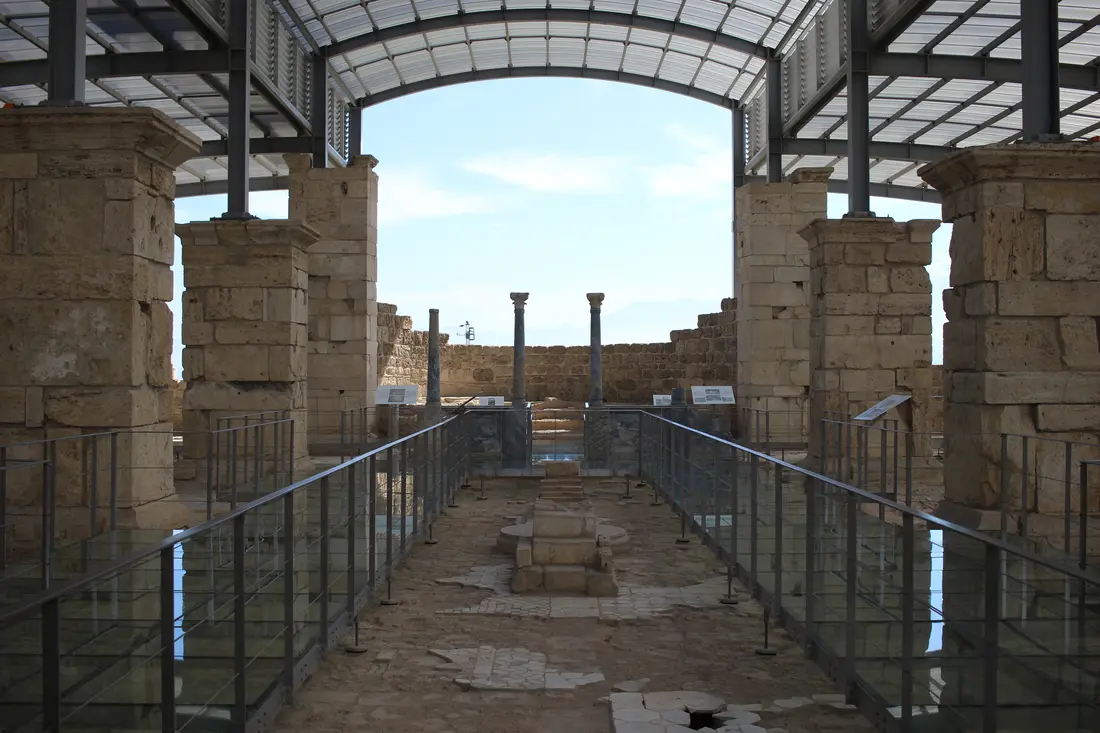
Laodicea, near Denizli, is the final congregation addressed in Revelation. The archaeological site contains streets, public buildings and an excavated early Christian church protected by a modern shelter. Give the guide time to separate the first-century congregation from the later church structure visitors see today.
Continue to Hierapolis and Pamukkale as one combined visit. Hierapolis is not one of the Seven Churches, but it appears in the New Testament context of the Letter to the Colossians. Later Christian tradition connects the city with St Philip, and the site includes the Martyrium of St Philip on higher ground.
The martyrium requires extra walking and should not be promised automatically to every group. Check the current route, mobility needs, weather and available time. Our Pamukkale and Hierapolis guide explains how to balance the ancient city with the travertine terraces.
Where does Colossae fit?
Ancient Colossae, associated with the Letter to the Colossians, lies near modern Honaz in Denizli Province. It is important to the Biblical story, but travellers should not expect a developed monumental site comparable with Ephesus or Laodicea. The location is principally an archaeological mound, and access or visitor arrangements should be checked locally.
Include Colossae only when its scriptural significance justifies the extra stop for your group. An academic or church study programme may value time for explanation at the landscape; a first-time visitor with limited hours may gain more from a deeper visit to Laodicea and Hierapolis.
How to complete all Seven Churches
The remaining congregations are Smyrna in modern İzmir, Pergamon near Bergama and Thyatira in Akhisar. Completing all seven requires a wider loop through İzmir and Manisa provinces before continuing to Ephesus and Denizli. Four focused touring days is possible; five days usually gives a better rhythm once hotel changes and arrival or departure times are included.
A sensible sequence depends on flights and the direction of travel. İzmir can work as the western gateway, while Denizli is useful for the eastern end. Do not count an airport transfer as a full sightseeing day. Our Ephesus and Pamukkale route guide can help with the non-pilgrimage transport structure.
Plan for the group you actually have
- Request a licensed guide experienced in Biblical and early Christian history.
- Share the denomination, study theme and preferred Bible translation in advance.
- Ask about slopes, uneven stone, shade and vehicle access at every site.
- Separate archaeological evidence, later Christian tradition and devotional belief clearly.
- Arrange Mass, worship or private ceremonies in writing before travel.
- Confirm opening arrangements, admissions and the final route shortly before departure.
For agencies, churches and academic groups, the best itinerary leaves room for reading, discussion and reflection. A faith-heritage journey should explain why the places matter—not simply prove that the vehicle reached them.